
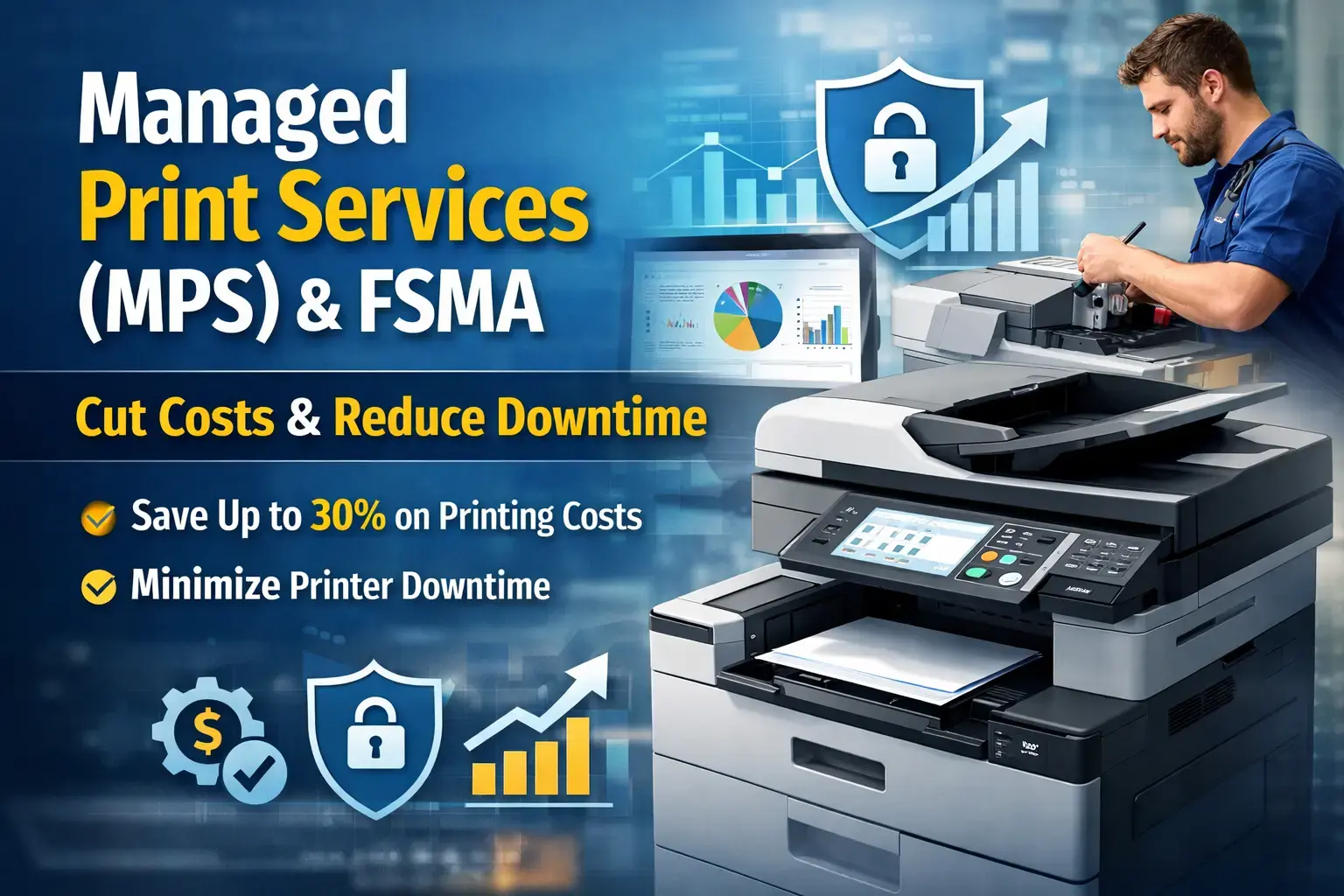
Office printing remains one of the most overlooked operational expenses in modern businesses. Research shows companies spend 1–3% of their annual revenue on printing, yet nearly 90% of organizations don’t track print costs accurately. As a result, unmanaged printing leads to waste, downtime, and security risks.
Managed Print Services (MPS) and Full Service Maintenance Agreements (FSMA) provide a structured, data-driven approach to printer management. Businesses that adopt professional print management report up to 30% cost reduction and higher equipment uptime.
For growing organizations, these solutions are no longer optional — they are essential for operational efficiency.
What is Managed Print Services (MPS)?
Managed Print Services (MPS) is a professional service that monitors, manages, and optimizes an organization’s entire print environment. Instead of reacting to printer problems, MPS uses proactive strategies to prevent them.
Industry studies indicate that printer-related issues account for nearly 23% of IT helpdesk tickets. With MPS, those disruptions are significantly reduced through automated monitoring and predictive maintenance.
Key Features of Managed Print Services
- Printer fleet assessment and optimization
- Remote monitoring and automated alerts
- Predictive maintenance and servicing
- Print usage analytics and cost tracking
- Supply management (toner and consumables)
- Secure printing and data protection
- Workflow automation
MPS transforms printing from a hidden expense into a measurable, controllable business process.
What is FSMA (Full Service Maintenance Agreement)?
A Full Service Maintenance Agreement (FSMA) is a comprehensive printer maintenance contract that covers repairs, spare parts, servicing, and preventive maintenance for a fixed cost.
Printer downtime can reduce employee productivity by 15–20%, especially in document-heavy industries. Unexpected repair costs also strain IT budgets.
FSMA eliminates these risks by ensuring:
- Priority technical support
- Free replacement of parts
- Regular preventive maintenance
- Minimal downtime
- Predictable maintenance costs
- Extended printer lifespan
Businesses operating high-volume printing environments benefit the most from FSMA contracts.
MPS vs FSMA: Understanding the Difference
Although both services improve printer performance, they serve different strategic purposes:
Managed Print Services (MPS) focuses on optimization, analytics, and cost control across the entire print infrastructure.
FSMA focuses on maintenance and uptime, ensuring printers run without interruption.
Many organizations combine MPS and FSMA to achieve maximum efficiency, reliability, and long-term savings.
How MPS and FSMA Reduce Business Costs
Unmanaged print environments lead to hidden expenses including paper waste, excess toner usage, emergency repairs, and productivity loss.
Companies using professional print management report:
- Up to 30% reduction in printing expenses
- 40% fewer printer breakdowns
- Improved document security compliance
- Reduced IT workload
- Better sustainability and lower paper waste
These savings compound over time, making MPS and FSMA a strategic investment rather than an operational cost.
Security Benefits of Managed Print Services
Printers are often ignored in cybersecurity strategies, yet they store sensitive documents and network credentials.
According to cybersecurity surveys, over 60% of businesses experienced print-related data vulnerabilities due to unsecured devices.
MPS strengthens security through:
- Secure user authentication
- Encrypted print jobs
- Access control policies
- Audit tracking
- Compliance-ready printing
Secure printing is increasingly important in finance, healthcare, education, and corporate sectors.
Why Businesses Are Switching to Professional Print Management
Modern businesses prioritize automation, cost control, and operational efficiency. Managed print environments align perfectly with these goals.
Organizations adopt MPS and FSMA because they:
- Reduce operational waste
- Improve productivity
- Provide predictable budgeting
- Enhance document security
- Extend equipment life
- Free IT teams from printer troubleshooting
As hybrid workplaces expand, centralized print management becomes even more critical.
Future of Smart Print Management
The future of office printing is driven by analytics, cloud integration, and automation. Advanced MPS solutions now use AI-powered monitoring to predict failures before they occur.
Businesses that modernize print infrastructure gain competitive advantages through efficiency and cost control.
Smart print management is no longer just maintenance — it is a strategic productivity tool.
Conclusion
Printing infrastructure directly impacts productivity, cost efficiency, and security. Businesses that rely on unmanaged printers face hidden expenses and operational risks.
Managed Print Services and FSMA create a reliable framework for cost control, uptime, and smart resource management. Organizations that invest in professional print strategies experience measurable long-term benefits.
Modern businesses cannot afford inefficient printing. Smart print management is a necessity, not a luxury.